
One March, Many Causes: Thoughts on the 2025 “People’s March”
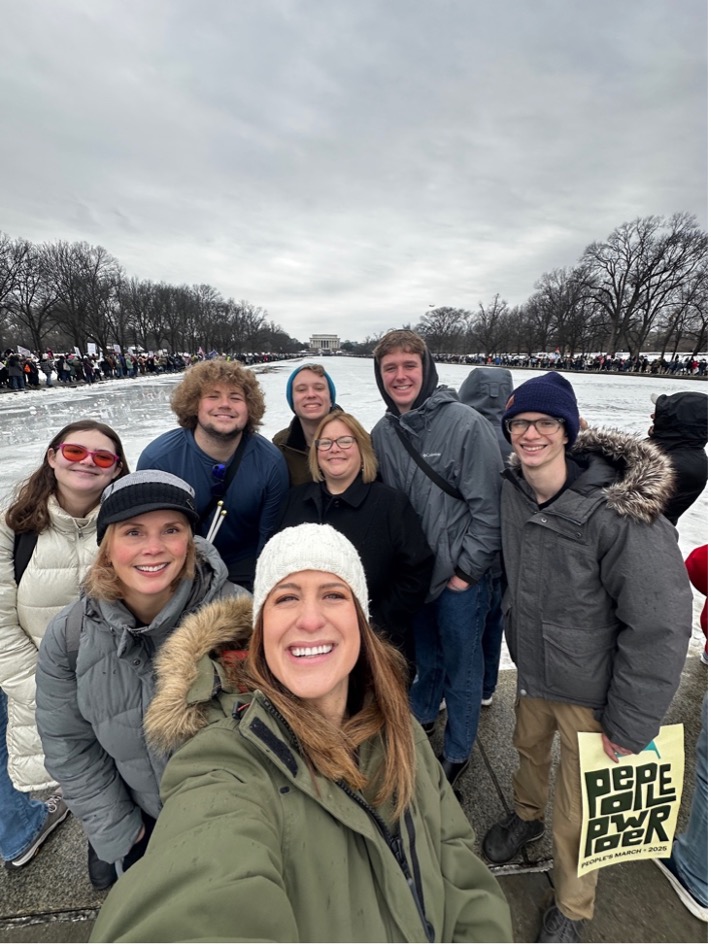
On Saturday, January 18, 2025, over a dozen Drake in D.C. students attended a demonstration called the “People’s March.” We approached the March as a learning opportunity to directly witness a major political and cultural moment.
The People’s March
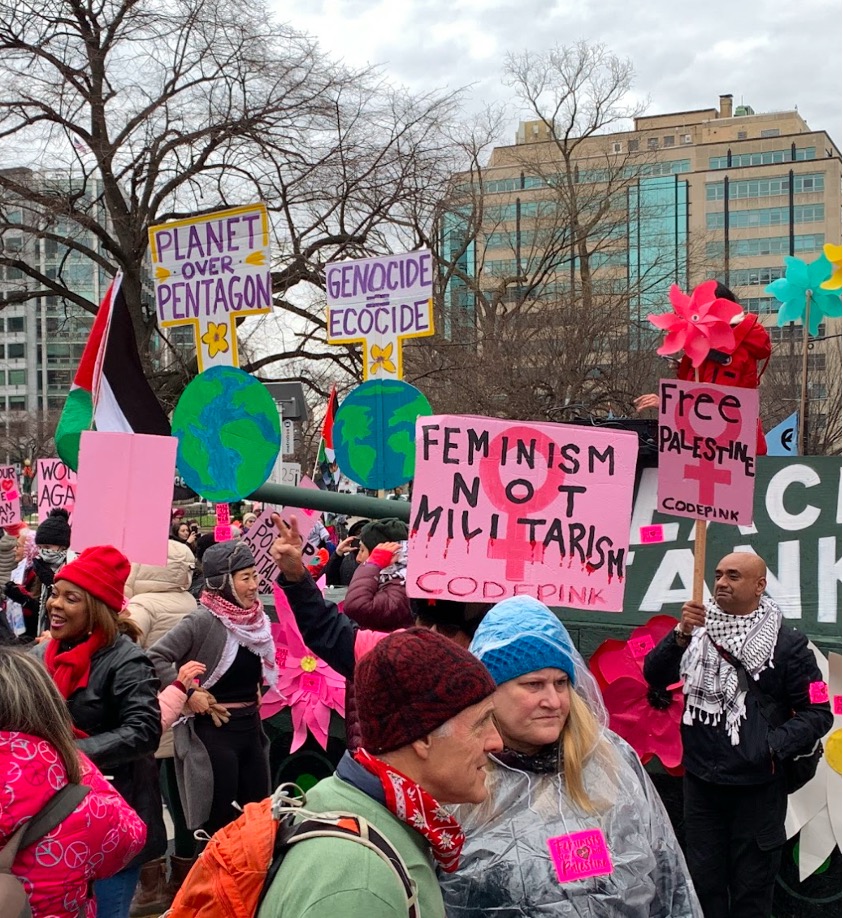
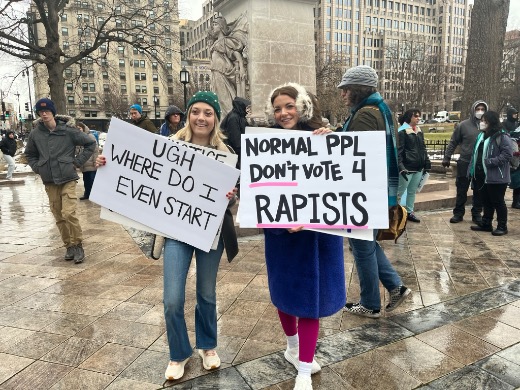
The People’s March described itself as a day of “joyful resistance, community building, and powerful action” in the wake of Donald Trump’s election and the incoming Republican trifecta. The People’s March consisted of three rally locations, each focused on different stated issues, which then combined to march to a large rally at the Lincoln Memorial. The Farragut Square kick-off location intended to focus on “democracy, immigration, anti-militarism, and climate.” The McPherson Square location was dedicated to issues facing D.C. The kick-off location we attended in Franklin Park centered on “bodily autonomy, gender justice, and LGBTQIA issues.” Throughout the March down to the Lincoln Memorial and the rally on the mall, we saw protesters carrying signs and chants in support of abortion rights, immigrants, the ERA, bodily autonomy, LGBTQ+ rights, Indigenous rights, Palestine, general women’s empowerment, D.C. statehood, gun reform, democracy, and more. There were also ample signs and chants opposing Trump, Republicans, rape culture, fascism, rich people, the January 6th attack on the Capitol, inaction on climate change, and expressing disgust and frustration in general. A smaller group of Drake students and faculty stuck around to observe some rally programming at the Lincoln Memorial. In the approximately 20-30 minutes that we watched the rally, a handful of speakers spoke about Indigenous land, anti-racism, gender-affirming care, abolition, D.C. statehood, reproductive rights, anti-fascism, climate change, antisemitism, and the “weaponization of antisemitism.”
Background
The People’s March did not just fall out of a coconut tree. When examining the March from a political science perspective, it is crucial to understand the context in which it exists and what came before it. The People’s March is, by and large, a rebrand of the organization that executed the 2017 Women’s March. In the years between the first Women’s March and the People’s March, there has been copious debate among progressive activists and organizers as to whether marches and protests are an effective agent of social change. Detractors of demonstrations as a political strategy malign protests and marches as performative. They argue that advocacy organizations’ limited resources would better be spent on grassroots political organizing in their communities. Proponents of political demonstrations, however, say that protests and marches foster an essential sense of community among civically engaged, like-minded people and inspire attendees to get involved in organizing for change.
An Expansion – And the Consequences
There was also criticism that the Women’s March was centered around white women and their priorities, lacking crucial intersectionality. My personal belief is that the expansion of the “Women’s March” to the “People’s March” was in response to these criticisms. In contrast to the 2017 march, on Saturday, a large portion of the speakers were Black, better reflecting the make-up of D.C, or were of other marginalized groups such as transgender or indigenous people.
However, there are potential consequences to broadening the subject of a protest as widely as the People’s March did. The point of a protest is to send a message of disapproval to people who can do something about it. Ideally, this message is clear and actionable. When one’s message is actually twenty different messages (climate change, abortion rights, trans rights, Indigenous land, free D.C., etc.) clumsily wrapped into one, the efficacy of the demonstration likely suffers. In discussions before and during the People’s March, some members of our group saw a connection between the lack of a clear, concentrated focus at the People’s March and the Democratic Party’s struggle to efficiently and favorably define itself in the Trump era.
In addition, when a lot of different causes are grouped together, one runs the risk of alienating anyone who does not agree with every plank of the platform. For example, a woman at the People’s March who supports abortion rights but opposes prison abolition may find herself rethinking whether this movement is right for her.
Conclusion
Ultimately, those of us in the Drake group who attended the March and rally were glad we did. We got to witness a moment in modern political history up close, which was even more meaningful considering that we are no longer able to experience a traditional inauguration. In addition, the People’s March has provided fodder for an interesting conversation and debate among the group about effective methods and tactics of political change.
A Well Connected Infrastructure
Written by Torin Johnson. Edited by Madilin Vrieze
The U.S. Capitol Hill area is very well connected through tunnels that run underground; these tunnels link the Capitol building itself to the nearby office buildings. The streets are lined with buildings that house the offices of all the representatives from both the House, and the Senate. It’s been super fascinating to be able to see behind the scenes of Capitol Hill, and learn what actually goes on inside these facilities.
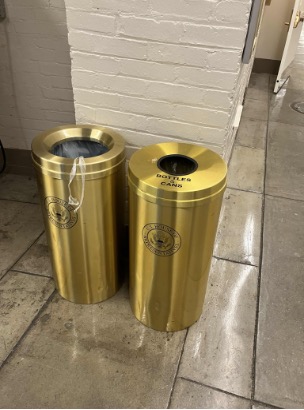
For example, inside the hallways there is exactly what you would expect to find; water fountains and trash cans. However inside of the US Capitol area, you’ll find the same thing, except made much more fancy, to appear as though they’re made of gold. Additionally, there was a large gold-looking door in the side of one of the hallways inside of the actual Capitol building, with “FIRE HOSE” written on it. I’d imagine that’s less trying to make commonplace items look fancy, and more a result of time. Keeping in mind how fire fighting infrastructure previously worked when the building was built.

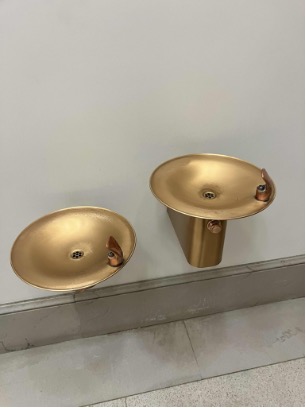
Overall, the tunnels varied in terms of quality. Some were much more polished, with walls that were clean with tiled off floors. But some were just flat out bricks, with concrete floors. The connections between the basements of each building especially were more rough in terms of appearance. There are lots of interesting things on those bottom floors; an office supply area, an area for staff which was filled with notebooks and folders branded with the seal of either the House, Senate, or Congress. There is also the famous gift shop for the office complex.. While most of the gifts in the gift shop were things that may be expected, such as mugs with the mentioned symbols of Congress, and special coins made to commemorate the inauguration, there was also simply a wall of cards, which felt somewhat out of place among the congressional memorabilia. I’m not entirely sure why it’s there, I could assume it might be for staff members to send quick messages for special occasions.

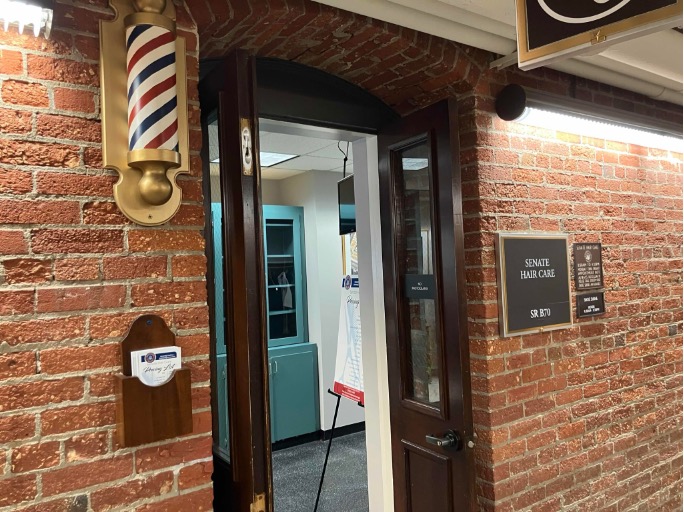
In the brick area of the tunnels, we also saw a barber shop inside of the Capitol. It even had one of those striped pillars outside as decoration. There was also a sign for shoe shining there, so members of the Senate can get both their hair and shoes done in the same place. I thought it was interesting, yet not surprising that that was there. If you’re a public figure, you’d want to be able to get your looks in check before rushing out to the media, so that you’d look cleaned up while on camera.
Inside of the office buildings, they also have their own full cafeterias. As the buildings are open to the public, anyone can come in and dine in the same place that people who work alongside members of Congress do. Upon learning of this for the first time, it almost seemed a little bit silly for those to be there, but it does in fact make sense. These are office buildings, after all. It was pretty cool to see them in person. You get a taste, literally, of what a meal looks like for those who work in these buildings in DC. There were also vending machines lined up in the tunnel areas of the basement, just in case anybody wanted to grab a quick snack while going from one office to another, to speak to other members of Congress.

Following the theme of food, the final interesting place I saw in the Congressional offices was that there were smaller cafes, outside of the main cafeteria, for people to hang out in. One such example is a place called Common Grounds, which is a coffee shop inside of the House of Representatives’ side of the office buildings. The name itself is also a fun joke, referencing the idea of finding common ground, or a similar position on whatever issue you may be discussing. Tied back to what was mentioned in one of the meetings that we’d attended as part of the trip, where we spoke to two House staff members, one Democrat and one Republican. They spoke about the importance of bipartisanship in working with the legislature, but also in how important it is to make connections. One of them mentioned something important to them is to go out and have a coffee or get lunch with people that work for other members of congress, even those that they wouldn’t expect to have any agreements with, just to get to know people. With a name like Common Grounds, that becomes a little more humorous.

Overall, spending so much time on our trip inside of the halls of the Congressional offices has been a surprisingly humanizing thing. While you’d expect these offices to be grandiose, they’re very small and cramped. The buildings themselves are just office buildings that anyone can go to. They’re not locked away, anyone can go visit. I think the little things here really show both how much goes in to these institutions, as well as how people that work here aren’t these far away bureaucrats that you never see who control everything, but they’re just people who live and work at their jobs, just like you or me.
The Power of Illumination
By Nora Miller. Edited by Madilin Vrieze
It has always been apparent to me that I do not have the most stellar vision. Whether something is at a distance near or far, you’d likely be able to catch me squinting, attempting to see an image or sign more clearly. It is also difficult for me to see things that are not well-lit. Often when there are things that I cannot see it is easy for me to disregard them and avoid any further struggle or strain on my eyes, and truthfully, I give little thought to what I may be missing. Missing visuals can often be irritating, but it wasn’t until my experience at the National Museum of African-American History that I truly experienced a moment of blindness.
When I entered the ground level of the museum we made our way into the first display room filled with images and stories of the origins of the Transatlantic Slave Trade. Many of the stories that I had heard in history class were depicted in this room, and all of the information felt incredibly familiar. I didn’t have to look very far to find familiarity. As we moved slowly through the rooms it was nearly impossible to read every piece of information on the walls and display cases, but many of the displays were written in bold white letters on glass making the material easy to see. However, moving into the next room it became clear that I would have a difficult time seeing information presented near displays.
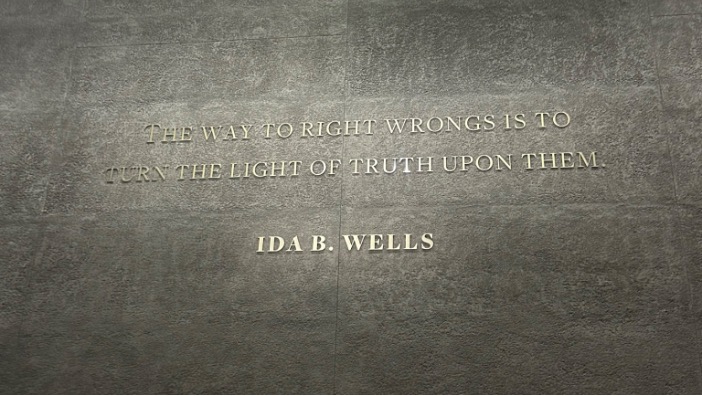
We made our way into the next part of the exhibit, and I was struck by the words of famous activists and poets on the walls. I gazed up to try and get a better picture of the words before me, but I realized I had an exceedingly difficult time seeing the words from the angle I was positioned at. I shifted my gaze to the large bronze plaque on the wall that clearly had more information about the exhibit, and I once again found myself facing the same issue. I could only read the bronze lettering if the light hit at just the right angle, and as a result, I had to continually shift my gaze and position in the room to take in any of the information.
I wandered over to my friend Amanda and shared my frustration with the visibility of the signs. We were mid-conversation when I had a moment of realization. I was supposed to be struggling to read the bronze plaques and quotes. I was in a museum dedicated to those Americans whose pasts and ancestry have been cast to the margins in history books and media to shield the majority from feelings of discomfort. It was only when the light hit at just the right angle that the stories of those who came before were truly illuminated and became visible to me. The light revealed the stories of the marginalized, and I needed to make an effort to learn the information. Whether this theory about the bronze panels is true or not I may never know, perhaps the architects simply loved bronze and decided to use it as their medium, but this thought stuck with me as I walked through the city and a question formulated in my mind – who else in D.C. didn’t have light illuminating their stories?

As we continued our day I took greater notice of members of the homeless community as the city has become more populated in preparation for Donald Trump’s inauguration. Even though we had only been in the city for a little over a week, it was clear that the focus of the city shifted to this historic moment. Barriers placed along sidewalks, Trump stores lining the sidewalks, police units from surrounding states, and reporters from around the world have arrived to cover all of the events in the city. Yet, I am left to wonder if any of these news organizations will cover the homelessness crisis in the city. Will police officers and government officials provide guidance to the community where shelter can be sought as a winter storm approaches? Or will the light remain detracted from those who do not seek the spotlight and headlines, leaving their stories invisible?
Throughout our time here, we have often discussed in large group settings how D.C. is home to some of the nation’s most iconic historical monuments and influential figures, frequently in the spotlight. However, our experiences have also drawn sharp attention to the homelessness crisis that persists despite the grandness of the city. While the Capitol stands illuminated at night and the Washington Monument shines brightly, it is evident that these lights do not always bring true illumination to the challenges faced by those living on the margins.
 Drake in DC